

































Standing on history: Who built Chicago’s WPA sidewalks?

On a warm spring day, there’s plenty to take in: birds chirping, flowers budding and neighbors out for a stroll. But Chicago’s more obscure details may go easily unnoticed. Look down and you may see that every few sidewalk squares are branded, either with an imprint or a metal plate.
Some keen-eyed Chicagoans have found sidewalk stamps that date back to 1904, like one that reads “Young and Olmsted” in the Rogers Park neighborhood. Another, on the 7000 block of N. Hamilton Ave., reads “Arthur Bairstow” from 1906.
At the turn of the 20th century, local U.S. governments made it a requirement for sidewalk contractors to sign their work. And Chicago’s municipal code still requires it so the city knows who did the (good or bad) job.
While many sidewalk stamps today are dated within the last 50 years, some read “WPA 1938,” calling back to desperate times in the city and country.

At the height of the Great Depression, national unemployment reached as high as 25%. People needed jobs, and the Works Progress Administration (WPA) was there to provide them. It was a work relief program, created in 1935 as part of President Franklin D. Roosevelt’s New Deal. The program included projects in writing, painting, academic research and domestic work. But the vast majority of WPA employment was so-called “shovel-ready” work, like paving roads, developing city parks and installing sidewalks.
If you see WPA sidewalk stamps today, a bridge or overpass has likely protected it from the elements, or it’s on a less trodden path. Unlike the writing, murals and propaganda posters created by artists of the WPA, the city of Chicago does not preserve sidewalk stamps. The history they symbolize is lost with each new sidewalk installed in their place.
But a history of burden and resilience behind the concrete remains intact. After years of being unemployed, WPA workers could earn wages. And as the New Deal era ushered in unprecedented protections for union organizing, workers could fight for fair conditions and dignity while building up the city.
The workers behind the Works Progress Administration
The WPA needed all the positive PR it could get. People criticized the program for being expensive and creating useless jobs for lazy workers. So the WPA used branding to counter that narrative.
The work program was one way to reestablish the dignity of earning a living, according to Tom Dorrance, a historian of the New Deal. Because so many Americans were unemployed (roughly every fifth person of working age wasn’t working), the program was implemented quickly and somewhat haphazardly, making it difficult to place people in roles that matched their skills. The majority of WPA employees worked on infrastructure and construction projects.
“You had people there who were really not prepared or able to do that kind of work, and are a little bit left in the lurch in terms of being given this job but not really having the physical capacity to do the work,” Dorrance said.
According to records from the Newberry Library, Illinois unemployment rates were so high that it was among the first states to get New Deal funding. In 1935, Chicago Mayor Edward Kelly had just been elected on a “work and wages” platform hitched to the New Deal. He then ushered in $150,000,000 in WPA dollars.

WPA jobs were often hierarchical; your race, gender and citizenship influenced where you were placed.
Women and immigrants were barely hired for WPA work. Women were often relegated to gendered labor, such as childcare, sewing projects and domestic work. Immigrants like Italians and Poles were placed in menial and low-paying jobs until 1939, when the WPA barred all noncitizens from the program.
When it came to race, Black workers in Chicago disproportionately held jobs with the lowest wages. Dorrance said African Americans tended to be the most in need: “There were far more Black applicants for WPA relief than there were white applicants.”
According to the Newberry Library, one-third of WPA workers in Chicago were Black, even though they made up roughly 7% of the population.
Black WPA workers were often given the most menial and difficult tasks, though some were skilled and educated in other areas. They were likely the ones stamping sidewalks across the city.
Chicago’s WPA workers unionized against the odds
By the mid-1930s, Chicago had long been a union town. When the WPA program took effect, tensions arose between public workers and privately contracted workers, who were largely represented by the Chicago Federation of Labor. Though their skills were comparable, WPA workers earned lower wages than their unionized counterparts.
Dorrance said the WPA did this intentionally.

“They didn't want to incentivize people staying on WPA jobs if there's private sector jobs available,” he said. “So they at least initially kept the wages below whatever the prevailing rate would be for equivalent private sector jobs.”
Normally, when unemployment rates are high, unionization is harder. Employers can easily replace defiant workers with the many unemployed people waiting in line. WPA workers risked it anyway.
“People work for the WPA long enough and have enough opinions about improving their conditions that sometimes they form unions,” said Eric Rauchway, a history professor at the University of California, Davis. ”Sometimes they go on strike against the WPA. And at one point, Franklin Roosevelt even meets with one of these union leaders.”
In 1933, two years before the WPA was established, the National Industrial Recovery Act was implemented, protecting collective bargaining. Rauchway said this encouraged unionization, even in the depths of the Depression.
In Chicago, the main organizing body of unemployed people was the Illinois Workers Alliance, who also represented WPA workers. Dorrance said early on, workers mostly disputed misaligned assignments, like manual labor they couldn’t do.
Then, “In 1937, with another funding act for the WPA, the wages were brought up to be on level with private sector jobs,” Dorrance said.
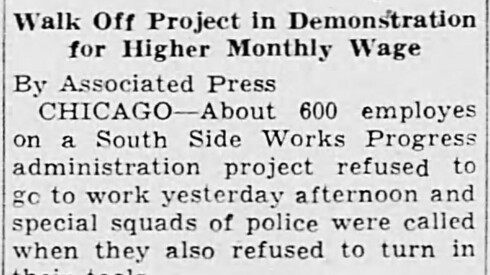
But getting fair wages was a constant fight. In 1939, the Woodrum Act cut the WPA’s budget and required employees to work more hours per month for less pay. Workers across the country resisted this. In Chicago, protesters picketed outside a WPA administrative meeting on Michigan Avenue.
In 1936, the percentage of unemployed people hired for WPA jobs peaked at almost 40%. Hundreds of artists were hired to document and portray the country’s history and community life. WPA conservation projects like the lagoons near Chicago’s North Shore are still intact today. Workers built thousands of roads, buildings, bridges and parks.
The WPA commissioned authors to write state guidebooks, including one for Illinois. “The WPA Guide to Illinois” may have captured the spirit of the laborers when describing Chicago as vibrant and noisy but more than its “youthful swagger”: “There is a legitimate sense of triumph for achievements in the past, a boundless self-confidence as it faces the future, in the challenging ring of its civic motto, I WILL!"
More about our question-asker
Bob Goldman is a lawyer living in the Edgewater neighborhood of Chicago.
One cold winter morning, he was walking his dog with his gaze to the ground.
“I was looking at the sidewalk, and I noticed for the 100th, 1,000th time those little stamps that are on the sidewalk,” he said. ”For whatever reason, this time, I thought, ‘That’s an old stamp.’”
The stamp read “WPA 1938” and it got him wondering: “Why are there stamps, and when did they start? And is the 1938 WPA stamp among the oldest?”
Goldman is a fan of Chicago’s many history buffs. He loves the idea that just taking a stroll on a regular day, there’s literal history underneath your feet.
What's Your Reaction?
 Like
0
Like
0
 Dislike
0
Dislike
0
 Love
0
Love
0
 Funny
0
Funny
0
 Angry
0
Angry
0
 Sad
0
Sad
0
 Wow
0
Wow
0