







































Chef Zubair Mohajir is having fun going into business with friends

Getting laid off tends to be a traumatic experience for the majority of people. However, for Chef Zubair Mohajir, a multiple James Beard Award nominee, “Chopped” winner and “Top Chef” contender, it became the day his life began.
“I was so freaking happy,” said Mohajir, 41, of his banking stint that ended in 2008. “But then I had to figure out what I do for work.”
Today, Mohajir is the chef and owner of the Michelin Guide-recognized Coach House, Lilac Tiger, Mirra and Sarima Cafe. He is opening three new concepts this year to add to his growing empire.

Mariela in the Loop (“a coastal restaurant based in nostalgia”) is slated to open on May 6; Muhājir in Lincoln Park (“the translation of it in Urdu, in Arabic, means ‘migrant,’” is an extension of the Coach House) will follow in the summer; and Bobo, (“a really vibrant bar where people feel like they’re stepping through a wildly disorienting, ‘Doctor Strange’-like portal, into the Manila night”) will be tucked away behind Muhājir.
After being laid off, Mohajir looked to his upbringing for inspiration on what to do next. Born in Chennai, India, Mohajir was raised in Doha, Qatar, before immigrating to Chicago’s suburbs in 1997. To make ends meet, his mother, Nasrin, took a job at Burger King, which she hated, he said.
“She went on to be a quality control check at a micro parts factory at Illinois Tool Works, which used to make micro parts for Motorola,” said Mohajir. She also set up an ad hoc catering business in their southwest suburban Frankfort garage serving time-strapped families in their community.
Food played a central role in the Mohajir household.
“I grew up being my mom’s prep cook on Saturday mornings, frying frickin’ samosas, making biryani, helping her cut onions for biryani. She planted that seed. I think she regretted it for a bit at the beginning of this journey. Now she’s all good, because we’re doing good,” Mohajir said.
He decided to become a cook and applied for a stage (essentially a short-term, typically unpaid, internship at a restaurant) at the world-renowned Alinea in 2013.
“At the time the requirements for getting a stage at Alinea was having two legs, two arms and being able to do some physical labor. They gave me this stage for four days with no restaurant industry experience. It was a spark for me. I was like, ‘holy crap.’ I didn't realize food could be at this level. I got addicted.”
He went to Bangkok in summer 2018 and worked at the critically acclaimed Gaggan, just as Wazwan, his pop-up supper club was taking off. Wazwan eventually found a permanent home at 1742 W. Division St. in Wicker Park, before evolving into Lilac Tiger. Coach House, a fine dining experience by Mohajir, opened in the rear carriage house.
The self-described “history buff” has made a name for himself by blending different ingredients and techniques that not only reflect his personal experience, but also a rich worldview.
“History is a big part of what I do, not only from a food standpoint, but I love to use it as a tool to really educate people,” said Mohajir. “We’re surrounded by a lot of ignorance these days. People don’t know where things come from, unfortunately, and food is the best way to dismantle barriers and really be able to connect with someone on a human level.”
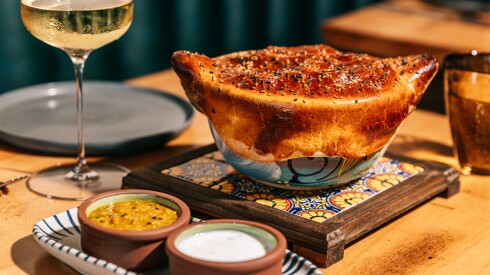
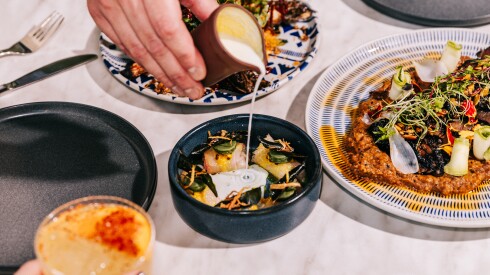
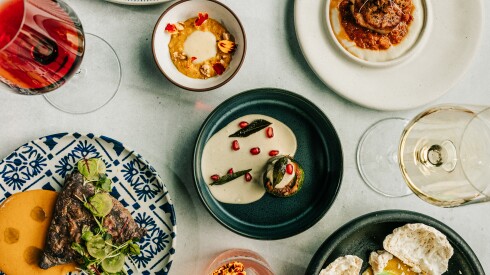
Take Mirra, for instance. In the age of short attention spans and people chasing social media virality, the restaurant concept of blending Indian and Mexican cultures on a plate could be perceived as a fantastical gimmick. On the menu, curry shows up alongside tacos, lamb barbacoa is married with biryani and sealed under a blanket of roti and Indian buttermilk yogurt is used in an aguachile bath that would traditionally be made of citrus.
Mohajir and his partner Chef Rishi Kumar invite diners to dig deeper with their Indian-Mexican concept.
“I was impressed,” said Mohammad Salehi, owner of Heray Spice who recently dined at Mirra with his wife. “We’re very picky eaters. Biryani requires real knowledge. It was excellent. You can feel the culture.”
The quest for depth begins with the restaurant’s name. It is inspired by the real-life tale of Catarina de San Juan, a South Asian woman kidnapped by Portuguese pirates, enslaved and eventually brought to Puebla, Mexico. Her birth name? Mirra.
“That blew my mind,” said Mohajir of the tale he first heard in 2021. “I reached out to Rishi about it. We had done a collaboration the year prior, mixing Indian and Mexican traditions at Bar Sótano when he was there. It was something that stuck with us.”
Kumar grew up in Singapore and celebrated life moments at Margarita’s, the island's oldest Mexican restaurant. That early exposure to Mexican cuisine would reappear throughout his career.
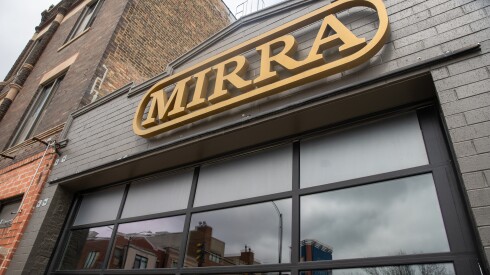
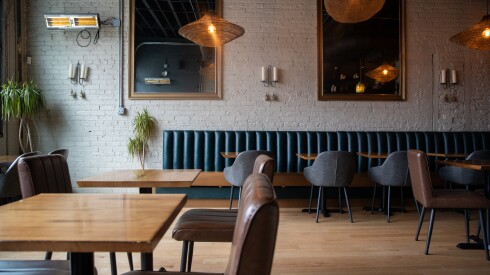
Before Mirra opened in its current space, it had been “turned over so many times, we were horrified by the fact that, ‘what if we’re just another statistic?’” said David Mor, beverage director and partner at Lilac Tiger, Coach House, Mirra, Mariela and Muhajir. “The landlord and neighbors told us that they’ve seen so many businesses go in there with very little success. Mirra was the biggest success story we could have ever imagined.”
Zubaer Khan/Sun-Times
“When I first met Zubair, he would come to me with ideas, and that’s when we came up with the chaas aguachile,” Kumar said of the dish, which blends Indian flavors like curry and buttermilk yogurt with Mexican ingredients such as serrano and nopales. It has since become one of Mirra’s signature items. Back then, Kumar was working for Chef Rick Bayless at Bar Sótano.
The chefs, neither of whom is Mexican, were less focused on producing replicas of traditional dishes and instead highlighting and celebrating the diaspora of flavors through migration.
“Growing up in Singapore, I knew a lot of South Indian cooking, which is Zubair’s main thing,” Kumar adds. “We clicked immediately, especially on flavor profiles. That led to a collab at Bar Sótano. We put the ticket sales up, and within a minute and a half, the whole 80 seats sold out. We had a 500-people wait list. Even Rick [Bayless] looked at me like ‘What did you guys just do? You unleash the beast?’ We were super excited.”
Mirra first debuted at the Coach House for an eight-month dining experience in August 2024. Sarima, his coffee shop that marries Indian and Filipino flavors (Chef Jacob Dela Cruz is a co-owner there), also began there before making the jump to a brick-and-mortar location in Wicker Park.
“That room is super, super special to me, because it put me on the map,” said Mohajir. “That’s where the first James Beard nominations came from: a room with no kitchen. I laughed so hard with pride when Michelin recognized us. It’s just such an intimate room. It’s beautiful, but there’s no kitchen.”
Today, Coach House has become a residency for up-and-coming chefs eager to test their concepts. Chef Junho Lee of Haru Haru, who attended culinary school alongside Mohajir, is serving diners his take on modern Korean food now through September.
Next month, Kumar and Mohajir are opening their latest venture together, Mariela, “a coastal restaurant that takes guests on a global coastal journey, shaped by migration, memory, and the movement of flavors across shorelines,” according to a news release. Some of the dishes, which continue the marrying flavors approach Mohajir and his partners have taken at their businesses, include seafood arroz negro with octopus, scallops, squid ink sofrito and uni hot sauce; tom yum aguachile with poached prawns, Thai herbs and smoked trout roe; and seafood kebab taco with grilled octopus, almond vanilla matcha and fenugreek roti.
“Mariela is an exploration of South Asian food through the lens of coasts around the globe. It’s a shining light on how food demonstrates our similarities, rather than our differences,” said Kumar, chef and partner of Mariela. “We represent chefs and lovers of hospitality collaborating on a unified vision that provides a balanced and intentional experience; whilst many restaurants and bars offer this, our curation brings a sense of independent thought, strong point of view, and deep love for delicious food and drinks.”
Despite all the success and recent growth, David Mor — beverage director and partner at Lilac Tiger, Coach House, Mirra, Mariela and Muhājir — wants people to know it hasn’t always been easy.

“We went through years of working together where we were constantly talking about ‘How do we pay rent this month,’ or ‘Can we ask for some of our co-workers to accept their paychecks a little bit later than what their payday is.’ It's the worst feeling as a business owner to do. You're taught that if you can't do all these things perfectly, you shouldn't go into business.”
Mor points to the first year in business being the most difficult and the team has since found a pace that allows them to take big bets on not only the concepts, but their real estate locations, such as Mirra in Bucktown.
“The space Mirra’s in has turned over so many times, we were horrified by the fact that, ‘what if we're just another statistic?’” said Mor. “We have some element of delusion or audacity built into what we do that kind of allows us to say, ‘It can't be worse than what we're doing right now, which is not owning our own [restaurants].’ The landlord and neighbors told us that they've seen so many businesses go in there with very little success. Mirra was the biggest success story we could have ever imagined. We've taken that momentum and that energy and said there’s nothing telling me that can’t happen again in a new location.”
The seven hospitality concepts Mohajir owns with several different partners do not operate under a parent company. That might change one day but for now, Mohajir says he’s just having fun going into business with friends.
“I really love opening restaurants,” said Mohajir. “Most people think too long about what moves they want to make. I dream about it, but I really pride myself and my team’s ability to just go out and do it. The best calls I like to make are to friends saying, ‘Hey, quit your job, move back. Let's open a restaurant.’ You attack the world differently when you're walking in step with somebody.”
Lamb Biryani
By Chef Zubair Mohajir
Man, a succulent lamb biryani just hits the spot after a day of fasting. All is well after a few bites of this dish.
Ingredients
For the marinade
2 pounds lamb leg, cubed into 1-inch chunks
2 to 3 teaspoons biryani masala
1 tablespoon ginger paste
1 tablespoon garlic paste
2 teaspoons kosher salt
1 tablespoon kashmiri red chili powder
½ teaspoon ground turmeric
¼ cup fresh mint leaves, chopped
2 tablespoons lemon juice
¾ cup plain yogurt
For the crispy fried onions
4 tablespoons ghee
1 large yellow onion, thinly sliced
For the rice
2½ cups extra long grain basmati rice
1 teaspoon black cumin seeds (shah jeera)
2 bay leaves (tamal patra)
1 star anise
4 green cardamom pods
8 cloves
1½ tablespoons kosher salt
For the garnish
½ teaspoon saffron
2 tablespoons warm milk
¼ cup chopped cilantro
Directions
Add all of the marinade ingredients to a plastic zip-top bag and mix well. Marinate overnight in the refrigerator.
When you’re ready to cook the dish, in a saute pan over high heat, fry the thinly sliced onions until golden brown, about 10 minutes.
Combine all of the rice ingredients in 3 quarts of water in a large pot and let soak for one hour.
Mix the saffron and milk together and set aside.
In a deep pot, sear all the meat and cook 75 percent until just tender. Reduce until all the liquid is cooked out.
Strain the soaked rice and then add to the pot. Mix well and add just enough water to cover the meat and rice.
Add the sauteed onions. Mix in the milk and saffron mixture and cover.
Cook for 45 minutes and let it rest for 30 with the heat off. Garnish with cilantro and serve.
What's Your Reaction?
 Like
0
Like
0
 Dislike
0
Dislike
0
 Love
0
Love
0
 Funny
0
Funny
0
 Angry
0
Angry
0
 Sad
0
Sad
0
 Wow
0
Wow
0


