















Bally’s hits Chicago casino construction milestone with fanfare — and big questions

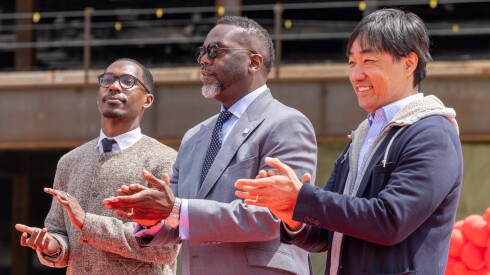
Mayor Brandon Johnson celebrated alongside Bally’s chairman Soo Kim on Thursday for the installation of the final support beam at the long-sought casino under construction in River West, which officials say is on track to finally open early next year.
All the company has to do until then is persuade state lawmakers to give them extra time operating their temporary casino, await potential discipline from state regulators for using a waste hauler once connected to the mob, and navigate competition from video gambling terminals that could light up across the city later this year.
It’s no small order for Bally’s. Then again, nothing has come easy for the Rhode Island-based corporation or city taxpayers during a four-years-and-counting casino saga marked by financial strain and logistical missteps.
“It's like the end of the beginning,” Kim said after watching the final beam hoisted by crane at 777 W. Chicago Ave., with the tune of Starship’s “We Built This City” blaring to a crowd of hundreds of workers, contractors and elected officials and other well-wishers.
“To get here, we just had a lot of random delays. Now it just feels real good. A thousand people working on-site — I can't believe how fast we're building now. So we feel good that we'll be open early next year,” Kim said, specifying only the first quarter of 2027.
He paused a gaggle with reporters to hug former Mayor Lori Lightfoot almost four years to the day after she handed the coveted casino license to Bally’s, which was initially expected to complete the $1.7 billion development in 2025.
Among the “random delays” to a project intended to supplement desperately underfunded police and firefighter pensions: a site plan overhaul after officials realized the original plan would’ve damaged water mains; the need to secure $940 million in outside financing; and a two-week work stoppage last year after the Sun-Times revealed a waste hauler dogged by mob allegations was working at the site.
The Illinois Gaming Board hasn’t said if it will fine Bally’s for the dumpster misfire.
“That was was one of our subcontractors,” Kim said. “We're cooperating with the investigation… If there's any criminality, you shouldn't be trying to work at a casino site.”
Bally’s didn’t face any city fines for a demolition mishap that sent cascades of debris into the Chicago River in 2024, but that cost them a few weeks of work, too.
As it stands, state law requires Bally’s to stop operating its temporary casino in early September, which will mark three years since the company launched its makeshift gambling house at the historic Medinah Temple.
Bally’s initially wanted to stand up a temporary casino on the site of the shuttered Chicago Tribune printing plant, but settled for the smaller Medinah at the behest of Lightfoot’s office, which had close ties to the temple’s well-connected landlord, Albert Friedman.
State Rep. Kam Buckner, D-Chicago, has filed a bill that would give Bally’s up to another year of temporary operation. It’ll have to pass by May 31 to avoid disrupting the temporary operation.
“We're not concerned,” Kim said. “I think everyone knows it makes sense to do, so we’re confident that we'll have good outcomes in Springfield.”

Other new casinos authorized under Illinois’ 2019 gambling expansion have feasted while Bally’s has gotten middling returns from Medinah Temple. It has churned out $311.6 million in revenue, generating $46.9 million in state tax revenue and $38.2 million for the city — far short of Lightfoot’s projections.
Johnson is still bullish on their prospects.
“The casino, the hotel, entertainment venue and restaurants are anticipated to generate more than $100 million in new revenue every year, which is going to make me and [Ald. Walter Redmond Burnett’s] job a little bit easier to pass budgets that are equitably maintained,” Johnson said.
But the budget that passed over Johnson’s objections by a recalcitrant City Council last fall paved the way for video gambling terminals in the city like those that have grown ubiquitous across most suburbs over the past two decades.
As of Thursday morning, at least 231 city establishments had applied to the gaming board, which will take months to vet applicants before any slots go live in Chicago bars, restaurants and other venues.
Bally’s had lobbied hard against the measure, complaining it will cannibalize the city’s potential gambling revenue. It also figures to wipe out the company’s host community agreement with the city, which had promised Bally’s wouldn’t face such competition.
“Bally’s keeps our promises, and we expect the city to keep their promises to us… People have to sort out what actually happens. It's a long journey,” said Kim, who promised the finished product will be worth it.
“This is a game changer,” he said. “There's nothing like this in the Chicagoland area. There's nothing like this for a long ways.”
What's Your Reaction?
 Like
0
Like
0
 Dislike
0
Dislike
0
 Love
0
Love
0
 Funny
0
Funny
0
 Angry
0
Angry
0
 Sad
0
Sad
0
 Wow
0
Wow
0


