


































Alexa Rice enters the beauty biz, on her own terms

On a recent Thursday morning, Alexa Rice paces inside a West Side photography studio, adjusting accessories and stepping in and out of frame as models hit their marks for the camera. In jeans, zebra print booties, and a vermilion t-shirt, Rice holds an easy and convivial command of the room.
“Oh, I love your tattoos,” says Rice, eyeing one makeup artist’s arm. “Oh! Yours too,” she adds, spotting the videographer’s designs. “I feel left out. The way my mother would never talk to me again if I got a tattoo.”
All around the aspiring beauty mogul, the Humboldt Park space has been transformed into a canopy of greenery, the setting for a marketing shoot launching the 37-year-old’s new Beech Beauty brand. When it’s time for Rice to take center stage, she quickly locks in. Rice is good in front of the camera, too.
Nearby, her mother, Linda Johnson Rice, in an elegant navy set and notably tattoo-free, soaks in the scene. “There’s something about this room,” she says. “I can feel it. It’s like Alexa’s grandmother is here with her, smiling ear to ear.”

At its peak, the Johnson empire included “Ebony” and “Jet” magazines, which together counted millions of readers; Eunice’s traveling runway show, Ebony Fashion Fair, that brought couture to Black America; and her cosmetics line of the same name. Here, Eunice Johnson (left), John H. Johnson (center) and Freda DeKnight (right) are at the Ebony Fashion Fair at McCormick Place.
Chicago History Museum, ICHi-175255; Stephen Deutch, photographer
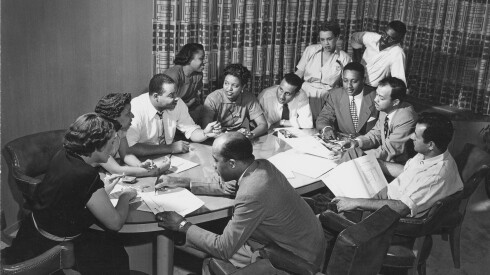
In a culture obsessed with beauty, Rice’s grandmother was a defining force in Black cosmetics and fashion. Eunice Johnson created the Ebony Fashion Fair, and Rice’s grandfather, John H. Johnson founded Johnson Publishing Company and became one of America’s first Black self-made millionaires. Rice was raised inside one of the most influential Black business dynasties in American history, and in a family that helped establish Chicago as a center of Black economic and cultural life.
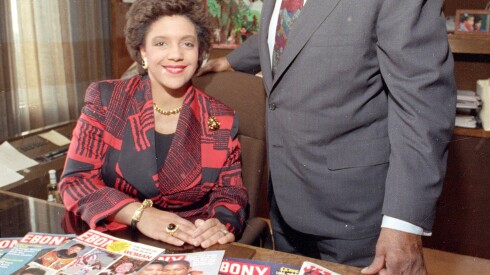
At its peak, the Johnson empire included “Ebony” and “Jet” magazines, which together counted millions of readers; Eunice’s traveling runway show, Ebony Fashion Fair, that brought couture to Black America; and her cosmetics line of the same name.
Fashion Fair was one of the first luxury beauty brands created specifically for Black women in an industry that had largely overlooked them. But as fate would have it, Rice wouldn't inherit the brand, which at its 1980s peak was carried in more than 1,500 department stores nationwide.
That reality now leaves her trying to build something of her own, in a market that has shifted dramatically. Starting Beech Beauty, says Rice, is a way to "feel closer to my family, and my grandmother specifically. And it's a way to continue our legacy."

A front row seat to an empire
As a kid, Rice — who radiates warmth and is quick to laugh, often at herself — didn’t fully register the scope of her family’s clout and impact. When asked about her grandparents, she starts small: her grandfather dropping to one knee so she could run into his arms (“I was a large child,” she laughs); her grandmother’s reading and spelling drills (“She was big on education,” she says); evenings spent watching “Murder, She Wrote” from the couch.
But Rice’s world was undeniably rarified, too. She remembers visiting the White House in 1996 when President Bill Clinton awarded her grandfather the Presidential Medal of Freedom. She had a precocious understanding of Valentino designs, and recalls wearing coveted Chanel flats to class at the University of Chicago Laboratory Schools. There were framed letters from the Kennedys and her mother’s annual Christmas party with a guest list that included criminal defense attorney Johnnie Cochran, all star athlete Bo Jackson, and future president and first lady Barack and Michelle Obama. Rice’s parents separated when she was young. Her father, André Rice, is the founder and president of a fund-of-funds private equity firm.
At one such party, when Rice was 11, she discovered she was allergic to cashews. Groggy from a heavy dose of Benadryl, Rice woke up to a familiar face.
“I said, who the hell is that?” laughs Rice. It was Michael Jordan, in 1999, at the peak of his powers, checking in on her. “He was around all the time.”

Rice also witnessed the empire unravel at close range. In the early aughts, Linda Johnson Rice, who took over as CEO at Johnson Publishing in 2002, faced a fast-changing publishing industry. Print advertising declined, subscriptions dwindled, and the company struggled to adapt to the digital era. In 2010, Linda sold the company’s Michigan Avenue offices, one of the first major downtown buildings designed and owned by Black Americans, and once a visible marker of her family’s success. In 2016, Clear View Ventures, a Black-owned private equity firm, bought both “Ebony” and “Jet.”
In 2019, Johnson Publishing filed for bankruptcy. The remaining assets, including an archive of more than four million photographs, were put up for sale through a court-supervised liquidation. The entire episode “was a very, very difficult and painful decision,” says Linda. “Really gut-wrenching, personally and professionally.”
One loss, however, was particularly crushing for both Linda and Alexa.
Fashion Fair, Eunice Johnson’s pioneering makeup line, had been more than a business; it was a living extension of Alexa’s grandmother. In November 2019, as part of the bankruptcy proceedings, the brand sold at auction for $1.85 million to an investor group led by former Johnson Publishing executive and close family friend, Desiree Rogers, along with Cheryl Mayberry McKissack, another Johnson Publishing alum.
Alexa says she and her mother believed there had been an understanding with Rogers that neither would bid on Fashion Fair during the bankruptcy proceedings. The pair were shocked to learn that Rogers was part of the group that ultimately acquired the company.
Linda prefers not to dwell on the episode. “That’s done for me,” she says. “People are gonna do what they’re gonna do, and there are things you can’t control. I cannot let that drag me down.”
Alexa, however, is more emotionally forthright. “It was the biggest devastation and betrayal I have felt,” she says. “I could not believe it. I was heartbroken.”
At the time, Alexa was a graduate student at Harvard Divinity School — for a while, she considered joining the ministry — and found herself sitting with that grief. “Divinity School is not a bad place to receive devastating news,” she reflects. “If you’re going to crash out, I recommend being with people who are training to be priests, pastors, and rabbis.”
Asked for her characterization of events, Desiree Rogers, now CEO of both Fashion Fair and Black Opal Beauty, another cosmetics brand for women of color, responded in an email: “JPC no longer owned the company when we bid [on] it. We were surprised and delighted that our bid was selected and that it would remain in the hands of African Americans.”
Looking back, Alexa says the experience clarified something for her: she and her mother may have lost Fashion Fair, but no one could take away the years Alexa spent at Eunice’s side, or what her grandmother taught her about color, skin, and a deep, enduring love of beauty.
“You can own the business,” says Alexa, “but you can’t own my grandmother.”
Look good while doing good
Enter: Beech Beauty.
The idea first came to Rice in her final year at Harvard, where she had been studying how disparities in green space shape city life. Rice wanted to find a way to connect those issues with the lessons she had absorbed from her family. So, as her final thesis project, Rice proposed a beauty brand that would donate a portion of sales to planting trees in underserved communities.
“My mom always says, why not look good while doing good?” Rice reflects.
The project was also inspired by Eunice, who raised over $55 million for Black organizations through Ebony Fashion Fair.
In 2023, Rice decided to give Beech a real shot. She chose to start small, with her own money, and from an office in her Gold Coast apartment. (Rice declined to say how much she has invested, but calls the amount “significant.”) Later this year, she will debut a line of lip glosses in seven shades, each named for a flower, along with a sweatshirt, both sold direct-to-consumer through the Beech website. And true to the original project, a portion of sales will go toward combatting environmental inequity.

“Alexa is not interested in just being an heiress,” says visual artist Theaster Gates, a close family friend and steward of the Johnson Publishing library, which is housed at his Stony Island Arts Bank on the South Side. “She is thinking about ways she can have a significant life and make a significant impact in the world. It’s a beautiful thing when a person finds the balance between recognizing the history they come from and not being burdened by it.”
Building the brand has been a process of trial and error. “I have done everything myself. I’ve gotten comfortable sending cold emails and making cold calls,” says Rice. “The worst that happens is they either don’t reply or they say no — I’ll live.”
Rice's first move was buying what she calls an “obscene” number of lip glosses, and testing how they wore over time. When Rice figured out what she liked — moisturizing with good color payoff — she found a California manufacturer and started working on her own formula. Rice was especially careful about how colors read on Black and brown skin. “A vibrant purple is going to show up so differently on me than it will on someone who looks like Lupita Nyong’o,” says Rice. “I wanted the shade range to take into account as many skin tones as possible.”
It took multiple iterations, she says, to create a product that felt inclusive, playful and bold. “This whole clean girl aesthetic, it’s just not for me,” says Rice, laughing at the current fad of dewy, fresh-faced minimalism. “I don’t know her. I wish her luck. She’s in my prayers, but that’s just not who I am.”
The result is a saturated lip gloss with a nourishing, emollient base that feels high-end, packaged with a ’70s-meets-millennial flair.

Connecting the past with a bright new future
Rice jumps into the beauty market at a moment when a spin through Sephora or Ulta feels like a red carpet award show. And while the market is huge — projected to surpass $700 billion globally this year — it is also crowded with everyone from conglomerates to celebrities like Hailey Bieber and Selena Gomez.
And it’s hard for Black founders to break through. According to Crunchbase, a database that tracks venture capital activity, less than 1% percent of all venture funding went to startups with a Black founder in 2024. The brief surge of support for Black-owned businesses post-George Floyd’s 2020 murder has largely receded.
None of this deters Rice because, she asserts, “if I’m not going to bet on myself, who will?”
Part of launching Beech Beauty, says Rice, has been launching herself. Over the past few years, the affable, droll founder has built a sizable following on social media, posting videos that toggle between stories about her grandparents, makeup tutorials, research on urban infrastructure, and lessons she’s learned while building a brand.
In one video, Rice lines her lips while detailing a new city ordinance aimed at addressing environmental racism. In another, she models Bob Mackie designs from her grandmother’s closet as she narrates the history of Ebony Fashion Fair. (Her impression of Wendy Williams as an owl is also a delight.)
Across her platforms, Rice’s aim is clear: connect her family’s past to a new chapter that is wholly her own.
@alexachristinarice Replying to @james Redlining is just one branch on the massive redwood tree that is environmental racism, but i hope this helps. I will definitely be revisiting this topic in the future becasue there’s a lot to say. Follow for more urban environment content! #urbanforestry #urbanforest #environmentaljustice #environmentalracism #redlining #treeequity #forestry #urbanplanning #arborist #arboristsoftiktok ♬ original sound - Alexa Rice | Beech Beauty💄🌳
From her apartment, set against a backdrop of taxidermy tiger skin (one of many expressions of her family’s shared fondness for animal print), Rice has begun planning Beech’s rollout for later this year. She will soon head to Los Angeles with her mother, who is developing several film and television projects based on the Johnson story.
A few years ago, Rice briefly considered moving to Los Angeles and building her business from there. The plan didn’t stick. “Chicago is where my family is, and it’s where I want to be,” she says. “My grandparents built their business here, so why can’t I?”
Any new endeavor, especially from a family like the Johnsons, will inevitably come with scrutiny. “There will be comparisons, there always are,” says Linda Johnson Rice. “But you don’t know if something can be a home run until you get up at bat. Alexa comes from a family that swings.”

Both Rice’s Beech Beauty and her mother’s new projects arrive at the same time as Theaster Gates’s forthcoming installation at the Obama Presidential Center, a large-scale collage of Johnson Publishing images celebrating Black womanhood. In addition, a consortium of foundations has committed $30 million to digitize the enormous “Ebony” and “Jet” photography archive and make it publicly available through National Museum of African American History and Culture and the Getty Research Institute.
The timing feels almost serendipitous, with the resurgence happening seven years after the bankruptcy filing. After all, the Johnson Publishing case was only finalized earlier this year.
As the only Johnson grandchild, that history can, at times, weigh heavily. But Rice doesn’t frame it that way. “I don’t take the weight,” she says. “I take the privilege, the uniqueness, and all the lessons of my upbringing in this family with me.” And that, adds Rice, no one can buy.
What's Your Reaction?
 Like
0
Like
0
 Dislike
0
Dislike
0
 Love
0
Love
0
 Funny
0
Funny
0
 Angry
0
Angry
0
 Sad
0
Sad
0
 Wow
0
Wow
0


